The Kelly Criterion
Seventy Years of Kelly
A formula only half a line long has, over seventy years, saved blackjack pros, a bond king, a Hong Kong racing syndicate and Wall Street's smartest funds — it isn't about how to win, it's about how not to go bust. F-Star turns this discipline into runnable code, verifiable backtests and a live on-chain allocation.
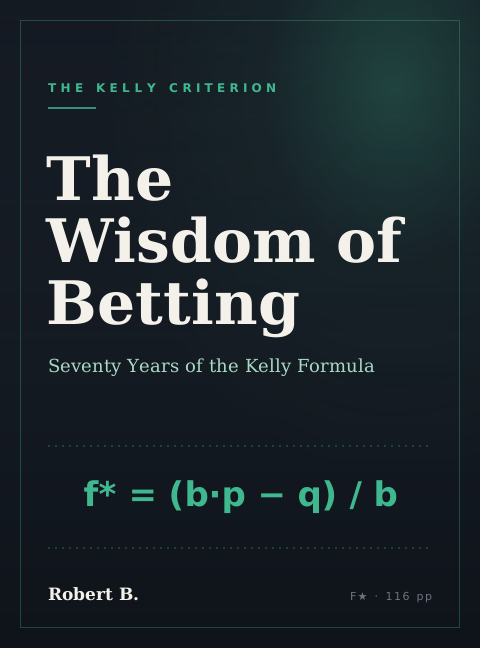
《The Wisdom of Betting》
Seventy Years of the Kelly Formula · from Bell Labs to Wall Street, from the racetrack to crypto
Thirteen stories, each with a real person and their encounter with the formula: Kelly, Shannon, Thorp, bond king Bill Gross, Buffett, Hong Kong's Bill Benter, and the cautionary tale of LTCM. Between the stories runs seventy years of the formula's evolution. The lesson: it's not about how to win — it's about how not to go bust.
by Robert B. · Singapore, spring 2026 · English original; Chinese is a translation
A Seventy-Year Timeline
From Shannon's information theory to Kelly in the age of AI
- 1
1948 · Information theory
Shannon publishes A Mathematical Theory of Communication, planting the seed.
- 2
1956 · A half-line formula
John L. Kelly Jr. publishes A New Interpretation of Information Rate at Bell Labs.
- 3
1960–1962 · Into the casino
Shannon hands the paper to Thorp; Breiman proves its long-run dominance; Thorp beats Reno at blackjack and publishes Beat the Dealer.
- 4
1971 · Onto Wall Street
PIMCO is founded (Bill Gross on the founding team); Merton derives continuous-time Kelly.
- 5
1988 · The power of compounding
Buffett buys Coca-Cola heavily; Thorp's PNP winds down after nineteen years with no losing quarter.
- 6
1994–1998 · The cautionary tale
LTCM launches at 30× leverage, loses 90% in three months in 1998; the Fed organizes a rescue.
- 7
2001 · A billion dollars
Bill Benter retires; Hong Kong racing winnings total roughly US$1 billion.
- 8
2023–2026 · The age of AI
LLMs integrate into Kelly systems, standardizing the 'rejection letter'; this book is published.
Thirteen Stories, Seven Protagonists
Everyone who truly used it survived — through discipline, not brilliance
John L. Kelly Jr.
1956The Bell Labs physicist who pushed the 'gambler with an inside wire' thought experiment to its limit and wrote the half-line formula. Died of a stroke at 41, never having used it.
Claude Shannon
SHANNONFather of information theory; handed Kelly's paper to Thorp; invested by the formula himself — 28%/yr over thirty years.
Edward Thorp
THORPThe math professor who broke Reno in 72 hours, then took Kelly to Wall Street — PNP had no losing quarter in nineteen years.
Bill Gross
BOND KINGFrom a $200 blackjack stake to PIMCO's ~$2T under management; his '2% rule' is the essence of Kelly.
Warren Buffett
OMAHANever writes the formula, yet embodies Kelly-style concentrated bets: Amex, Coca-Cola, Apple. Munger: 'four stocks is enough.'
Bill Benter
HONG KONG RACINGA Pittsburgh physics grad who, with a 100+ variable model and a 1956 formula, won US$1 billion at the Hong Kong track.
LTCM
CAUTIONARY TALETwo Nobel laureates, 30× leverage, US$4.6B gone in three months in 1998 — had they heeded the formula, they could have survived.
Samuelson
THE DISPUTEA Nobel laureate wrote an all-monosyllabic paper to mock Kelly; seventy years on, those who use it are still here.
Formulas, as Code
Every formula in the book runs inside the F-Star engine
Kelly has more than one form: binary bets, continuous markets, risk-aversion adjustment. The book's Appendix A gives the cheat-sheet; F-Star's lib/kelly-formulas.ts implements each one, with values matching the book's tables exactly.
// f* = (b·p − q)/b, q = 1−p; equal odds b=1 → 2p−1
export function binaryKelly(p: number, b: number): number {
  const q = 1 - p;
  return (b * p - q) / b;
}
// binaryKelly(0.60, 1) === 0.20 ← matches the book// f* = (μ − r) / σ²
export function continuousKelly(mu: number, sigma: number, r: number): number {
return (mu - r) / (sigma * sigma);
}
// S&P500 (μ=10%, σ=16%, r=3%) → 273% full / 68% quarter-Kelly
// BTC (μ=25%, σ=70%, r=2%) → 47% full / 12% quarter-Kelly| ASSET | Μ | Σ | FULL Π* | ¼ KELLY |
|---|---|---|---|---|
| S&P 500 | 10% | 16% | 273% | 68% |
| CSI 300 | 8% | 22% | 124% | 31% |
| BTC | 25% | 70% | 47% | 12% |
Generalize single-asset Kelly to a multi-strategy portfolio and you get lib/kelly.ts behind F-Star /allocate: edge from Sharpe, fractional-Kelly weights, risk-cap constraints — the same math that allocates capital into top NovaMarket pools on Arbitrum One.
Why Quarter-Kelly
Appendix A.4: give up a little growth, and you survive
Full Kelly grows fastest mathematically, yet carries roughly a 50% chance of long-run ruin. Fractional Kelly trades a little growth for a large jump in survival — which is why F-Star /allocate defaults to quarter-Kelly.
| KELLY FRACTION | GEOMETRIC GROWTH KEPT | VOLATILITY (VS FULL) | LONG-RUN SURVIVAL |
|---|---|---|---|
| Full · 满凯利 | 100% | 100% | ~50% |
| 3/4 | 94% | 75% | ~80% |
| Half · 半凯利 | 75% | 50% | ~90% |
| Quarter · 1/4 凯利 | 44% | 25% | >99% |
Computed deterministically by lib/kelly-formulas per Appendix A.4 (growth kept = 2α − α²); illustrative, not a promise.
From Formula to Live
F-Star is the living reference of this math
- 1
Theory · the book
The Wisdom of Betting shows how, over seventy years, this formula saved people and was ignored — the source of the discipline.
- 2
Code · lib/kelly
Every Appendix A formula runs as TypeScript in the F-Star engine, matching the book's tables.
- 3
Backtest · fractional Kelly
The full / half / quarter-Kelly growth-vol-survival comparison that justifies the quarter-Kelly default.
- 4
Live · /allocate
This math runs on Arbitrum One: pick NovaMarket strategies → Kelly weights → one signature to allocate.
Mainnet gray-scale phase · not investment advice, not a return promise; projections are targets/estimates. This reference is about the discipline of not going bust — not a promise of winning.