RESEARCH2026.05
Applying Kelly in High-Vol Crypto: Calibrating Quarter-Kelly in Practice
Why almost no one runs full Kelly — and how to balance volatility, correlation, and tail risk in practice.
→
KELLY, APPLIED
“Most people fail at investing not for lack of a winning strategy, but for want of position sizing and risk control.”
The Kelly fraction f* has run for seventy years — from casino blackjack and Hong Kong racing to the bond king, Wall Street and crypto. F-Star turns it into a capital- and fund-management model: sourced from NovaMarket's public track records, sized by Kelly (quarter-Kelly by default), offered as two services — self-directed allocation (non-custodial, straight from your wallet) and on-chain smart-contract custody (fund to be established · small test); and it explains Kelly's applications across domains (a story + an algorithm each).
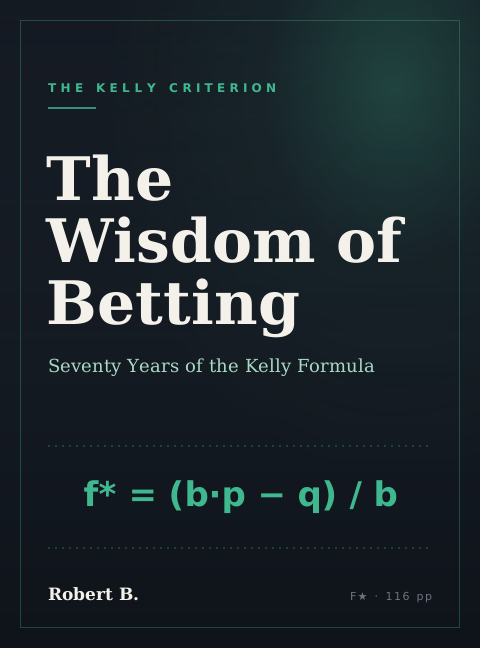

The Wisdom of Betting · Seventy Years of the Kelly Formula
Use Kelly — but half-Kelly or less, because you always overestimate your edge.
F* is named after this formula — all of F-Star's discipline starts from this half line
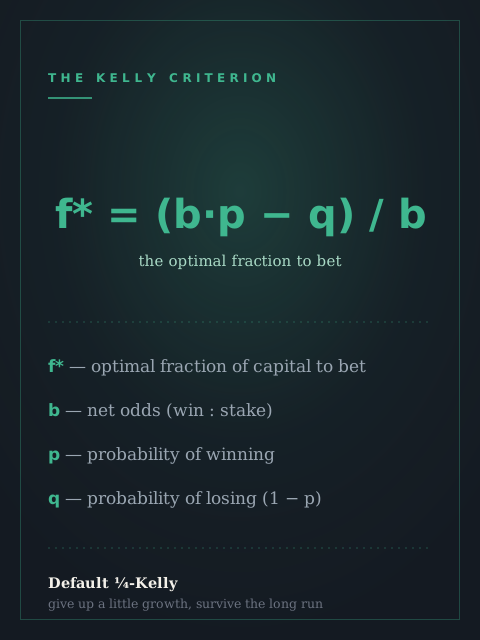
The Kelly Criterion was published by John Larry Kelly Jr. at Bell Labs in 1956. Given win probability and odds, f* is the betting fraction that maximises the long-run growth rate of wealth — which is where F-Star takes its name, and the core of this crypto asset allocation service.
“The optimal fraction to bet is the one that maximizes the expected logarithm of wealth.” — J. L. Kelly Jr., 1956
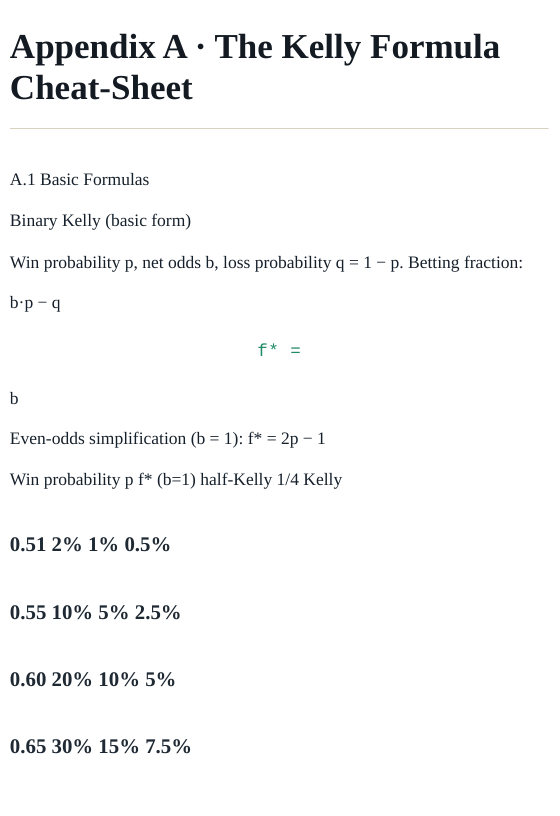
F-Star turns this math into code: `lib/kelly-formulas.ts` implements each formula from the book, and `lib/kelly.ts` generalizes single-asset Kelly to a multi-strategy portfolio, defaulting to quarter-Kelly with risk caps. Give up a little growth for long-run survival — that is the default discipline of the F-Star crypto asset allocation service.
From Bell Labs to Wall Street — one formula, the same advice across generations.
The optimal fraction to bet is the one that maximizes the expected logarithm of wealth.
Use Kelly — but half-Kelly or less, because you always overestimate your edge.
My 2% rule I learned from blackjack.
Concentrated investing beats diversification — high conviction, big positions: exactly what the Kelly formula tells you.
Most people fail at investing not for lack of a winning strategy, but for want of position sizing and risk control.
Overconfidence is the Kelly formula's greatest enemy — all overbetting springs from it.
Full Kelly is mathematically optimal and psychologically fatal; quarter-Kelly is the discipline you can keep for a lifetime.
The direction of compounding matters more than its speed.
It isn't about how to win. It's about how not to go bust.
Each application = a story + an algorithm (formula and code). The last one is the point: the non-custodial crypto asset allocation service built on F-Star.
Put seventy years of Kelly discipline to work on your crypto — non-custodial, self-served, discipline-first.
Sourced from NovaMarket's public track records; multi-strategy Kelly, quarter-Kelly by default.
Risk caps and diversification — think about not going bust before growth.
F-Star holds none of your assets: connect your wallet, sign and execute yourself.
Allocation, positions, P&L and redemption all on-chain — Arbitrum One mainnet (gray-scale).
Protocol design, contract audits, and Policy development guides
Why almost no one runs full Kelly — and how to balance volatility, correlation, and tail risk in practice.
A cross-sectional analysis of the evolving stablecoin yield structure in H1 2026.
Tracking stablecoin and ETH flow across L2s over the past six months.
Select NovaMarket strategies, let F-Star size them by Kelly, and self-execute from your wallet. Give up a little, get long-run survival — the most important lesson of seventy years of Kelly.
Non-custodial · mainnet gray-scale (Arbitrum One) · not investment advice or a return promise.
f* = (b·p − q) / b